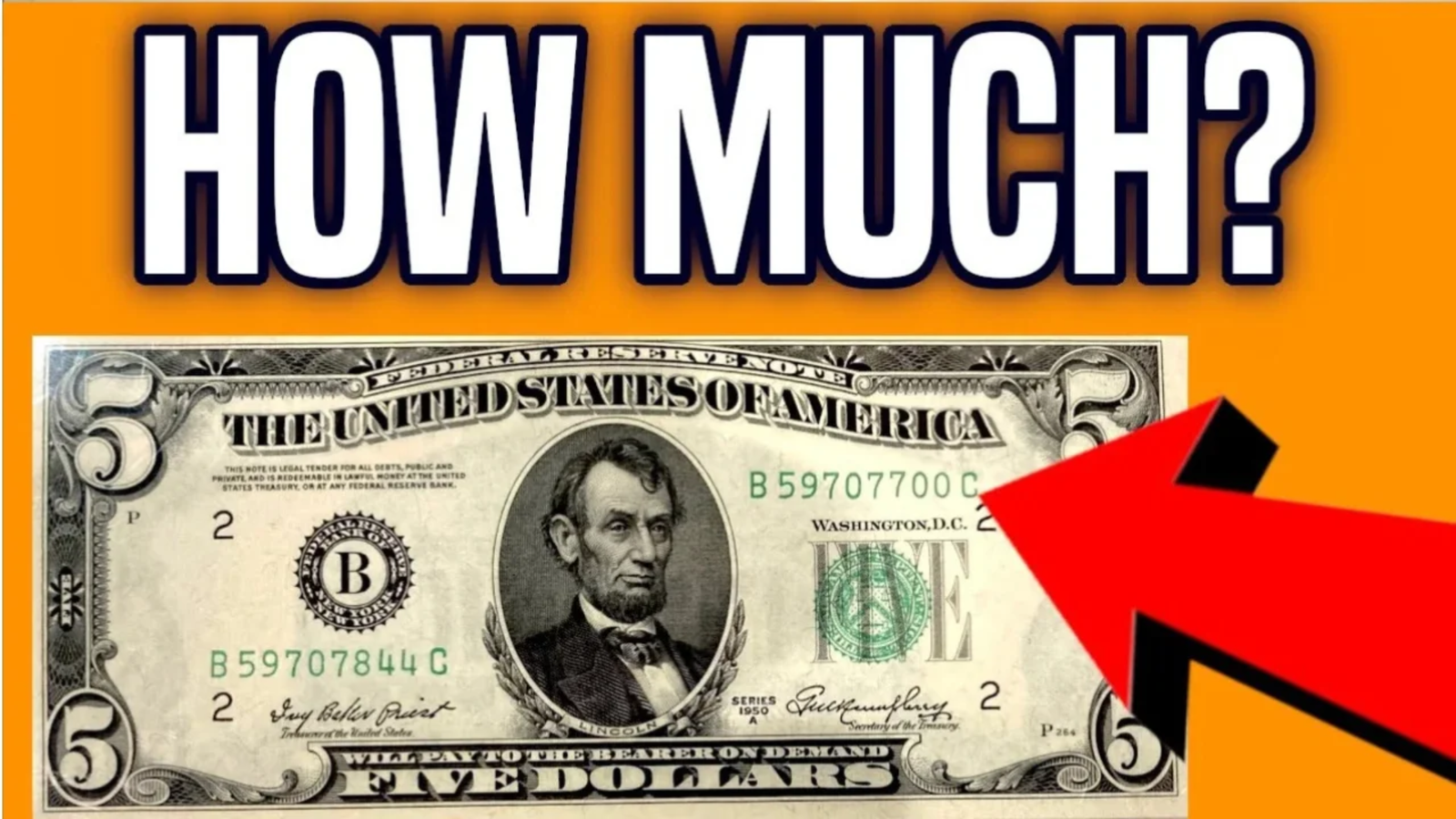
Check the Money in Your Pocket: Imagine pulling out an ordinary $5 bill to pay for coffee and suddenly realizing it has a printing mistake that makes it worth hundreds or even thousands of dollars. Thousands of 1995-series $5 bills were accidentally printed with the Treasury seal upside down. These “inverted seal” errors are highly collectible.
What Is the 1995 Upside-Down Seal $5 Error Bill?
In 1995, the Bureau of Engraving and Printing (BEP) made a rare mistake while producing Series 1995 $5 Federal Reserve Notes. On some sheets, the green Treasury seal and black Federal Reserve seal were printed upside down compared to the portrait of Abraham Lincoln. Everything else on the bill looks normal – only the two seals are rotated 180 degrees.
These errors slipped past quality control and entered circulation. Today, collectors call them “Inverted Seal Errors” or “Upside-Down Seal $5 bills.”
Why Are These Error Bills So Valuable?
Normal 1995 $5 bills are worth exactly $5. But the upside-down seal version is extremely scarce. Experts believe only a few thousand exist in all conditions. Depending on how crisp the bill is, recent sales show:
| Condition | Average Sale Price (2024–2025) |
|---|---|
| Circulated (folded, worn) | $500 – $800 |
| Very Fine (lightly used) | $900 – $1,200 |
| Crisp Uncirculated (like new) | $1,500 – $2,000+ |
One gem-quality example sold for $2,300 at auction in 2024!
Step-by-Step: How to Check Your $5 Bill in Seconds
Follow these easy steps – no magnifying glass needed:
- Take any $5 bill dated “Series 1995” (look under the Treasury seal for the year).
- Hold the bill with Lincoln facing you normally.
- Look at the green Treasury seal on the right side of Lincoln’s face.
- Correct seal: The eagle’s wings point UP and the word “TREASURY” reads normally.
- Error seal: The eagle’s wings point DOWN and “TREASURY” is upside down.
- Check the black Federal Reserve seal on the left – it will also be upside down on error bills.
If both seals are upside down – congratulations, you probably have the rare error!
Quick Identification Table
| Feature | Normal 1995 $5 Bill | Rare Upside-Down Error |
|---|---|---|
| Series Year | 1995 | 1995 |
| Green Treasury Seal Direction | Right-side up | Completely upside down |
| Black Federal Reserve Seal | Right-side up | Completely upside down |
| Serial Numbers | Normal | Normal |
| Current Market Value | $5 | $500 – $2,000+ |
Which Federal Reserve Banks Have Known Errors?
So far, upside-down seal errors have been confirmed from these districts (letter on black seal):
- B – New York
- E – Richmond
- G – Chicago
- H – St. Louis
- L – San Francisco
Bills from Atlanta (F) and Dallas (K) are especially rare in error form and bring the highest prices.
How to Protect and Sell Your Rare Find
If you discover an upside-down seal $5 bill:
- Do NOT fold or wash it – keep it flat in a plastic sleeve.
- Get it graded by PCGS Currency or PMG (professional grading adds value).
- Sell through reputable auction houses like Heritage Auctions, Stack’s Bowers, or even eBay (with authentication).
Frequently Asked Questions (FAQ)
Q: Are all 1995 $5 bills with upside-down seals valuable? A: Yes! Every confirmed inverted seal example is considered an error and starts at $500 even in worn condition.
Q: I found a 1995 $5 with only ONE seal upside down – is it real? A: No. On genuine errors, both the green Treasury seal and black Federal Reserve seal are upside down together. If only one is rotated, it’s likely someone tampered with the bill.
Q: Can I still spend it if I want? A: Yes, it is still legal tender worth $5 at any store. But you would be spending hundreds or thousands of dollars!
Q: Where is the best place to sell it fast? A: For quick cash, local coin shops often pay 60–70% of value on the spot. For maximum money, send it to a major auction house.
Q: Are there similar errors on other $5 years? A: No. The 1995 upside-down seal is the only known major invert error on modern $5 bills.
Conclusion:
Next time you get change, break open that old wallet, or sort through birthday cash from grandma – look closely at every Series 1995 $5 bill. It only takes 10 seconds, and you might be holding a small fortune. Thousands of these rare upside-down seal errors are still hiding in drawers, jars, and piggy banks across America. One lucky person will find the next one – make sure it’s you!